Ferry Logo

Ferry Logo

Wednesday, 24 September 2014

Lady Northcott Turns Forty


The oldest remaining Lady Class ferry, the Lady Northcott, turns 40 on Friday. She and the Lady Herron are the last in a line extending back to the steamer Lady Mary, which was launched in 1892.  

All the Lady boats were double ended screw ferries, ideally suited to coming and going from Circular Quay without the need for cumbersome manoeuvring. 

The world's first double ended screw ferries were developed for the Clyde River, Scotland. Sydney's North Shore Ferry Company quickly followed suit, launching Australia's first double ended screw ferry, the Wallaby, in 1879. The Wallaby was designed by famous naval architect Norman Selfe. 

Selfe's designs were later perfected by Walter Reeks in the form of the Lady boats, with the Lady Mary and Lady Napier introduced to service in 1892 by the Balmain New Ferry Company. The Lady boats have continued in service on Sydney Harbour for an unbroken 122 years, surely a record in the history of public transport.

The Lady Northcott was designed by naval architects Barnes and Fleck and built at Carrington Slipways in Newcastle. It was launched on 26 September 1974, but first went into service on 31 January 1975. It has been a stalwart of the Taronga Zoo and Mosman lines, but is not suited to the tight turning required in Neutral Bay, Mort Bay Balmain or Darling Harbour. It is sometimes used as a back up to the Manly Ferry. With a passenger capacity of 800, it has also performed heroically in moving large crowds to and from events at Cockatoo Island.                           

Tuesday, 23 September 2014

What drives patronage - speed, frequency or fares? Part 2: Parramatta River

Commuter Peak Parramatta River and Cockatoo Island Line Configuration, October 2013 
New ferry timetables in October 2013 added capacity to commuter services on the Parramatta River.

A limited stop service was introduced in the AM peaks for the Middle River (Rydalmere to Abbotsford), with boats running direct from Abbotsford to McMahons Point and Milsons Point, before terminating at Circular Quay. 

For those further down the River, the story was not so positive. AM peak services to Circular Quay from Chiswick, Huntleys Point and Drummoyne were diverted to Balmain (Thames Street), adding about five minutes to their commute. This change eliminated the need for special Inner Harbour services to take people travelling from Balmain to McMahons Point and Milsons Point.

Limited stop services are popular with many passengers. Who wants to be take a milk run to work every day?  They do, however, come at a cost. To maintain the same service frequency at each stop, more vessels are needed. If additional capacity is not available, then frequency must be reduced. A compromise somewhere in the middle (which is what happened in this case) is the other possible outcome.

The table below shows the changes in service frequency by wharf as a result of the new timetable. Five wharves lost one service, three gained one and Rydalmere lost two services. These include boats travelling to Darling Harbour and Circular Quay. 


Week-day departures for services arriving at Circular Quay or Darling Harbour by 9 am

The impact of the changes on journey time are shown in the next table. Middle River locations were the main beneficiaries. Longer average journey times for lower River locations were ameliorated by Darling Harbour services, which continued to run direct from Drummoyne.   


Average time journey time (minutes) of week-day services arriving at Circular Quay or Darling Harbour by 9 am  
So what has been the impact of these changes?

The Bureau of Transport Statistics has recently released the results of a ferry census conducted in November 2013, a month after the new timetable came into effect. A census was also conducted in the same week in 2012, allowing a "before and after" comparison to be made.

The changes in AM peak commuter patronage, shown in the table below, is striking. Demand from the lower River has dropped by over 15% and by 9% in the middle River, despite the faster trips. Gains at Sydney Olympic Park and Kissing Point were more than offset by reduced demand at Cabarita and Abbotsford.


 Week-day boardings on services arriving at Circular Quay or Darling Harbour by 9 am

One bright spot was Balmain, which was up 22%, but this is probably explained by special circumstances in November 2012. The wharf was closed for upgrade at that time with passengers using a temporary wharf at Yeend Street.   

Despite two extra sailings in the AM peak runnings and two additional vessels, commuter patronage has declined by nearly 6% on the Parramatta River/Cockatoo Island routes. Average loadings per sailing are down from 91 to 78.   

One fat frog does not make a cane toad plague. The census is only taken over one week and there can be data inaccuracies. Changes to the MyMulti ticket products, discussed in the previous post, are likely to have had an impact too.

But the numbers show a striking pattern. It is a pattern consistent with what transport planners in European cities have said for a long time - keep the network simple and maximise frequencies.    


  •  

Friday, 29 August 2014

What drives patronage - speed, frequency or fares? Part 1: Rose Bay and Manly

 
Sydney Ferries recorded impressive patronage growth of 6.9% in 2013-14, making it the second fastest growing public transport mode in Sydney (behind light rail).

But has the commuter market grown or did last year's long dry spell bring out more leisure and other off peak travellers?

Every six months, a census is taken of all Sydney Ferry boardings and disembarkations over one week. The information is captured in detail (down to individual wharf and service) and reported by the NSW Bureau of Transport Statistics www.bts.nsw.gov.au/Statistics/Ferry/default.aspx .

Leisure numbers are strongly affected by seasonal factors and weather. But commuter patronage in the AM peaks is more consistent. This makes it possible to speculate about the impact of timetable or fare changes on these services, by comparing the same week across years.

Data from the November 2013 census has just been released. Two major policy changes happened between November 2012 and 2013:

  • Rules were changed for the periodical ticket product "MyMulti". Before 1 September 2013, all ferry passengers could use a MyMulti 1 ticket. This was changed to the more expensive MyMulti 2 for Inner Harbour ferry passengers and to the highest priced MyMulti 3 for Manly ferry passengers. Bus users were not affected. 
  • Significant changes to ferry timetables, mainly affecting the Parramatta River and Eastern Suburbs, were implemented in October 2013.
MyMulti 1 tickets were popular with regular Manly Ferry commuters.  The change lifted the price of weekly MyMulti tickets for these passengers from $44 to $61, an increase of 39%.

So what happened to patronage?

For the sake of brevity, this analysis focuses on AM commuter peak passengers from Manly and Rose Bay, plus the aggregate AM peak.  A review of the Parramatta River will follow in Part 2 in three weeks time (when the author returns from a holiday).
     
A proxy measure for regular work commuters is the count of passengers who catch ferries terminating at the CBD terminals by 9.00 am on week-days.    


Mean daily boardings on services arriving Circular Quay at or before 9.00 am (week-days)

The Manly timetable was the same in both years, but passengers were affected by the MyMulti ticket changes. Almost 15% fewer passengers caught the Manly Ferry in the AM commuter peak in the last week of November 2013, compared to the same week in 2012. That's a drop of 254 passengers each morning, or the equivalent of six additional busloads on Military Road. 

Rose Bay figures are the big surprise. Rose Bay peak services were supplemented in the October 2013 timetable changes, moving from 30 to 20 minute headways. But the additional capacity has not been matched by increased patronage. Total AM peak numbers actually dropped almost 9%. Perhaps Rose Bay commuters who need to change modes at Circular Quay are using other transport options in response to the MyMulti ticket revamp. 

The apparent drop in AM commuter peak numbers is not limited to Rose Bay and Manly. The data shows that passengers arriving at Circular Quay and the other main destination wharves on week-days at or before 9.00 am were down 9.6% on the same week in November 2012. 
Mean daily disembarkations at main destinations at or before 9.00 am (week-days)


Wednesday, 27 August 2014

Why getting names right helps public transport legibility


There was a time when Milsons Point Luna Park wharf was just called Milsons Point. It was changed about two years ago to the longer four word version, perhaps to help customers who don't know where the iconic amusement park is located.

But the change had another impact. 

There is also a Milsons Point train station, which is about five minutes walk from the ferry wharf.  A passenger catching the F4 line from Balmain East or Pyrmont Bay can change at Milsons Point to catch a train on the North Shore line. Where such transfers are possible, all modes should use the same stop name. This is because it highlights to the irregular user that a transfer is possible.

So "Milsons Point Luna Park" wharf should still be called plain "Milsons Point".

The other side of the coin is Sydney Olympic Park wharf, which is 2.8 km  from Sydney Olympic Park train station, as the crow flies - hardly a convenient walk. The wharf is actually located in the suburb of Wentworth Point and is nowhere near either the sport stadium or another transport terminal named Sydney Olympic Park.

To avoid confusion, Sydney Olympic Park wharf should be called Wentworth Point.

These issues may seem trivial for the regular user of a network who has become accustomed to its many idiosyncracies, but it can be baffling to a visitor or  infrequent user if consistent naming conventions are not followed. As highlighted by Terzis and Last (2000) in the Urban Interchange Good Practice Guide, the badging of an interchange is one of many factors which contribute to customer awareness and use of transfer opportunities.   


Tuesday, 19 August 2014

Is Sydney getting best value from its wharf upgrade program?


Previous posts on this blog have highlighted the importance of well designed ferry terminals which allow passengers to quickly disembark and board.

Sydney's commuter wharves are the responsibility of Roads and Maritime Services (RMS), not the ferry operator or Transport for NSW, as many people might assume. RMS is in the middle of a major wharf upgrade program which will cost about $70 million. Five new wharves have already been built and a further seven are planned.

A major investment into transport infrastructure of this scale is normally made in the context of a detailed network plan covering the life of the new terminals and modelling of expected passenger movements at individual locations. 

The design solution should take account of the different characteristics of passenger movements at different locations. At some wharves passenger movements are mainly one directional. Crowds either board the vessel in AM peaks or disembark in PM peaks at a commuter wharf like Mosman or Thames Street Balmain, but not at the same time.

At other places, like Pyrmont Bay which mainly serves leisure passengers, large numbers can disembark and board the same vessel. It is not uncommon for more than 100 people to disembark at Pyrmont Bay while another 100 are waiting to board. For passenger safety and to minimise dwell time, it is vital that any new wharf is designed to ensure efficient egress and ingress of passengers.   

Sadly this will not happen at Pyrmont Bay. The "cookie cutter" strategy adopted by RMS in constructing previous wharves will continue at Pyrmont Bay, apparently without detailed analysis or modelling of predicted crowd movements. The recently announced wharf design shows:
  • a small pontoon, similar in size to Thames Street Balmain wharf
  • seating positioned longitudinally in the middle of the pontoon, which is likely to interfere with passenger egress and ingress
  • no indication of how passengers waiting to board a ferry will be separated from disembarking passengers.  It is probable the crowds waiting to board on a busy Sunday afternoon will extend up the ramp, blocking the exit of disembarking passengers.       
   

At a busy terminal like Pyrmont Bay with two directional crowd movements, dwell time can only be minimised if two gangways are used, preferably double gangways. The small size of the pontoon and the positioning of fenders and seating make it unlikely that this will be possible. This means the opportunity to fix a key systemic shortcoming in the ferry network will be lost.

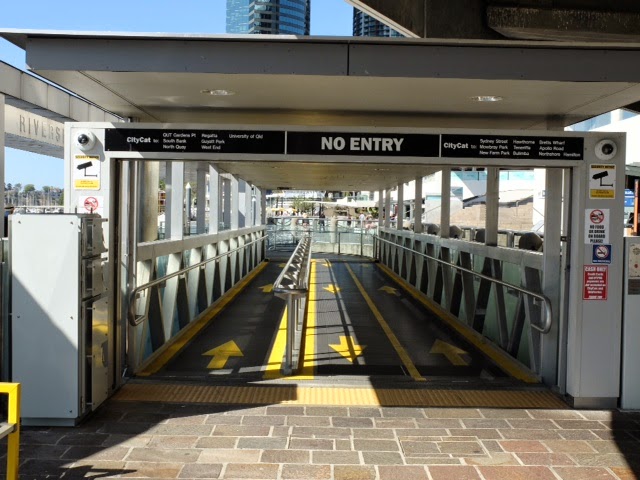
It is curious and frustrating that Sydney wharf design falls well short of the standards set by many other ferry networks, including Brisbane's. Here is an example of effective separation of boarding and disembarking passengers on the ramp at the Riverside ferry terminal Brisbane.


Tuesday, 5 August 2014

Are Periodical Ticket Discounts Really that Great?

Monthly, quarterly and annual MyMulti Tickets will not be available for purchase from 1 September 2014. This is part of a move to a totally "pay as you go" model for Sydney's public transport under the Opal card. 

Some argue that the price of periodical tickets is too heavily discounted in Sydney. This partly stems from comparisons between the price of MyMulti Yearly and Quarterly tickets and the cost of using an Opal card. The logic seems to be "if the Quarterly and Annual ticket price is more favourable than using Opal, then the periodical ticket products must be too cheap".

But if we were to compare MyMulti prices with monthly and annual fare prices in other cities, Sydney's periodical tickets are actually very expensive.


An Annual MyMulti 1 ticket costs 530 times more than a single train trip. In London, an Annual ticket is 430 times the price of a single train trip. In European cities, the discount is even greater. Annual tickets range from 211 times the single ticket (Amsterdam) to just 115 times in Munich.

As the average resident of Munich and Zurich makes 400-500 public transport trips per year, it is not surprising why the take up of periodical tickets in those cities is so high.

Sydney's recent flight from periodical tickets goes against the tide of international practice, which is to embrace them. The international bible of public transport best practice is the Hi Trans Guide. Among the seven top measures it lists to improve public transport is to "cut fares through the provision of integrated season tickets".

The benefit of season or periodical tickets is that, once purchased, passengers have an incentive to make as many public transport trips as possible. Each additional trip comes at no extra cost. 

But in order to encourage the purchase of a periodical ticket, the customer needs to be satisfied that they will make enough trips in the future to justify purchasing it upfront. That's why European cities keep the price of periodical tickets low. 

Having an Opal card is very convenient for passengers, but it could make a much greater contribution to growing public transport use if it included periodical fare options. London's Oyster card does this. And why not make it even easier by allowing users to specify when automatic payment deductions are made, such as on their fortnightly or monthly payday?

Wednesday, 30 July 2014

Ferry Connections: Part 2 - Interchanges

A ferry operation can be viewed as a system made up of infrastructure elements (fleet and terminals), its customers, staff and a timetable. It is an open system, heavily influenced by the maritime environment, Government policy and regulation, the operation of other modes of transport and many other factors.  

Few aspects of this system are as important as ferry terminals, especially interchanges where passengers transfer from one line to another, or to or from another mode. In a harsh maritime environment, there can be a preoccupation with engineering issues and perhaps less attention on efficient ingress and egress of passengers or how the terminal fits with the overall network plan. 


Eagle Street Ferry Terminal Brisbane
 
The reliability of the network and the convenience of transfers between boats is largely a function of interchange design and how well it matches the vessel fleet.

Where an interchange is well designed, passengers can disembark and board quickly. If this happens, and the design of the fleet is compatible with the terminal design, there will only be a small variation in boarding time between a light loading and a heavy loading. This in turn helps ensure scheduled connections are met.  

To achieve this happy situation, there are two main requirements of the interchange:
  • capacity to deploy multiple, wide gangways. A single, narrow gangway only allows one passenger at a time to board or disembark. It takes one minute for 50 passengers to board via a single narrow gangway, and longer if there are passengers with strollers or special needs. If 100 are disembarking and 100 are boarding, then the boarding process takes four minutes or more. This is an unacceptably long dwell, not including the time needed to plank/ remove the gangway and tie lines. The solution is to provide for two wide gangways at all high demand wharves, which enable four to six passengers to board simultaneously.
  • keeping disembarking and boarding passengers separate at high demand terminals. If the wharf pontoon is too small, the crowd of passengers waiting to board interferes with the egress of disembarking passengers. Passengers transferring between vessels also need to be accommodated efficiently.
Each interchange must be an appropriate adaptation to the particular location and circumstances of its location. A "one size fits all" approach to designing wharf upgrades is doomed to failure.   

In last week's post, a network plan for Sydney Ferries was outlined with six locations where dual berthing wharf facilities are needed. It is not enough to simply say "this wharf needs to be dual berthing". There must be a visualisation of how these interchanges will work in practice, taking into account the proposed timetable and the implications for vessel and passenger movements. The goal should be to make sure dwell time is minimised and passengers can move safely and quickly between vessels.

At the outset, it should be noted that a classical 'four way' interchange that you might expect in a rail network, where two lines intersect at a four platform station and trains in both directions on both lines arrive at the same time, is not something you would want to replicate in the Sydney Ferry network, outside of Circular Quay. The cost of infrastructure to support this would be significant and not necessary unless transfers in all directions are imperative.

Some less grandiose models are suggested here.

1. Corner Connection

Network requirement:  two lines intersect at a terminal; transfers are required in some, but not all directions. Cremorne Point is an example of a corner connection in the proposed Sydney Ferry network described in the previous post. In this case, transfers from Barangaroo and Rose Bay in the direction of Mosman (and return) need to be possible, but it is not necessary for there to be transfers in the direction of Circular Quay. This means the Mosman to Circular Quay vessel can depart ahead of the other three.
    
Terminal design solution: required transfers can be supported, without conflicts, with a double length dual berth pontoon. The following diagrams show the order of vessels berthing and departing. Note that the connecting 225 bus arrives first allowing passengers to transfer to Circular Quay, Rose Bay and Barangaroo and departs last with passengers disembarking the ferries. In this case, a single ramp is shown, but separate ramps for boarding and disembarking passengers could be provided if needed.


2. T Connection

Network requirements: A T connection occurs where a wharf is the terminus of one line and an intermediate stop on another. An example is Rose Bay, assuming it is the terminus of a Ring Line connecting the Eastern Suburbs with the North Shore and Barangaroo, as well as an intermediate stop in both directions for the Watsons Bay line. In a situation like this, it is preferable to minimise the dwell for vessels on the Watsons Bay line to avoid inconveniencing passengers who have not completed their journey. There is scope, however, for a layover for the Ring Line as Rose Bay is the terminus. 
Terminal design solution: In this T connection, the inbound and outbound Watsons Bay vessels berth simultaneously at Rose Bay. As the vessel from Barangaroo is also in a layover at the same time, three berths are required. The simplest way to accommodate this is to use a double sided pontoon which is perpendicular to the shoreline and long enough to allow the Barangaroo vessel to berth "in the corner". 


These examples of terminal design show the importance of long term planning in the design of the network and timetable. Unless this is done, the supporting infrastructure may not meet future requirements.The Swiss Federal Railways develops its timetable 20 years in advance. This creates a sufficient lead time for infrastructure improvements to be put in place and minimises reworking and waste.