A regular theme of this blog is the need for urban ferry planning to be approached from the perspective of transit planning theory. Mariners who take on the task of network planning without a proper understanding of public transport network theory do themselves a great disservice.
(Equally, public transport planners who tinker with waterway networks, without first developing a deep understanding of the peculiar constraints of maritime environments, do so at great peril).
An excellent recent contribution to public transport policy is "The Public City: Essays in Honour of Paul Mees", edited by Brendan Gleeson and Beau Beza and published by Melbourne University Press. The essay by Tim Petersen, Public transport beyond the fringe, provides a beautifully clear explanation of how low density populations can be effectively served by public transport.
The essay has relevance to urban transit ferry systems where demand levels may not justify high frequency services.
Low frequency services are normally equated with low quality, but Peterson shows that quality, and high usage, is still possible with 30 or 60 minute headways
Petersen uses the small town of Trullikon (population 600) in the Canton of Zurich as an example of how public transport can achieve a high mode share without high population density.
Trullikon is not on a railway line, but it has a bus service which connects with the train and operates at 30 minute intervals from 6 am to 8 pm, Monday to Friday and hourly between 8 pm and midnight. A modified span of service operates on week-ends.
Despite its low density and small population, 19% of journeys to work from Trullikon are by public transport. No city in Australia, apart from Sydney, achieves this level of public transport use for the journey to work.
According to Petersen, Switzerland's pulse timetabling and high punctuality are critical ingredients to success.
He states further:
"Overarching bodies like Zurich's ZVV (the co-ordinating government transport agency) or Graubünden's AEV are essential for the planning and governance of a Swiss-style network. Standardised system headways and operating hours are basic requirements of an effective pulse system, and there will inevitably be some lines that have weaker patronage levels and must be subsidised by stronger services. A multi-modal fare system that allows transfers without penalties is needed and a large pool of long-term travel pass holders is also an advantage".
We have in Sydney the co-ordinating agency (Transport for NSW), but unfortunately pulse timetabling and the right fare structure do not appear to be on the agenda.
Ferry Logo

Friday, 17 April 2015

Thursday, 26 March 2015
A better approach to public transport commitments
In State election campaigns, we have come to expect political parties to make commitments to individual transport projects - a new rail line, bus route or ferry wharf.
But the quantity of projects, or their dollar value, are not synonymous with community benefit.
A better approach would be to articulate principles and present a well thought out long term strategy.
New infrastructure is needed, but what are the principles that guide the selection and specification of individual projects? Without those principles, NSW will not get value for money, and is unlikely to achieve a discernible mode shift from car to public transport.
Here is a list of four things that need to be included in a public transport strategy for Sydney:
But the quantity of projects, or their dollar value, are not synonymous with community benefit.
A better approach would be to articulate principles and present a well thought out long term strategy.
New infrastructure is needed, but what are the principles that guide the selection and specification of individual projects? Without those principles, NSW will not get value for money, and is unlikely to achieve a discernible mode shift from car to public transport.
Here is a list of four things that need to be included in a public transport strategy for Sydney:
- A long term commitment to building a multi-destinational network. Only a small percentage of travel in Sydney is the trip from home to work - and a small fraction of these are trips to Sydney CBD. A substantial increase in public transport travel (and a drop in car trips) will only happen when PT can be used to travel to wherever you need to go, at a time that suits you. This is not as unrealistic or costly as might be assumed, but it does require intelligent network planning and integration. And it does mean Sydney PT users must get used to more journeys which include a transfer.
- Speed, frequency and simplicity are key elements of a successful network plan, plus measures to increase reliability. Practical strategies include fewer, straighter routes, greater distance between stops and more bus priority lanes.
- Priorities for infrastructure projects will be determined by the network plan. Developments which have the biggest impact on achieving the long term network plan should proceed first.
- A modified fare structure to remove disincentives to public transport travel. This means removing penalties for transferring between modes, adopting the same fares for all modes and offering heavily discounted monthly, quarterly and annual travel passes. We don't want people to ration their use of public transport, as happens in the current pay as you go system. We want them to treat it as though it is free!
Thursday, 19 March 2015
Thoughts on expanded NYC ferry services
The history of ferries in New York City and Sydney have plenty in common.
Both cities relied heavily on ferries for urban transit in the nineteenth and early part of the twentieth century, before bridge building, metropolitan rail systems and private motor vehicles shrunk the market.
A double ended screw propelled ferry, the Wallaby, first operated in Sydney in 1879, designed by innovative colonial naval architect Norman Selfe. Double ended screw ferries started in New York nine years later with the launch of the Bergen in 1888 by the Hoboken Ferry Company.
Both cities embraced this style of vessel because of their suitability for short haul transport. As double enders, they saved lost time on reversing manoeuvres and screw propulsion was more efficient than the traditional paddlewheel.
Sydney naval architect Walter Reeks, who perfected the double ended screw ferry in the Lady Class boats from 1891, commented on the "wonderful similarity" between the solutions independently developed by the New York and Sydney ferry operators.
While New York's ferry operations declined more rapidly than Sydney's, a rejuvenation is happening in both cities in the twenty-first century.
New York Mayor Bill de Blasio announced in February an expansion of the NYC ferry network from 2017 to reach all five boroughs. This will complement the existing East River Ferry which started in 2011.
It has to be said that ferry ridership around New York is not huge. The free Staten Island ferry carries 22 million passengers each year, but the NY Waterway ferry ridership was a more modest 8.5 million in 2014. That compares with 1.7 billion passenger journeys on the New York subway.
Where geography dictates that water transport offers a more convenient alternative to other modes, it sometimes surprises that ferry ridership is not higher. This can lead to some scepticism about service expansion, especially where taxpayer subsidies are involved.
Without pretending to be an expert on New York City transit, here are three suggestions (unsolicited) for making urban transit ferry expansion more successful:
Both cities relied heavily on ferries for urban transit in the nineteenth and early part of the twentieth century, before bridge building, metropolitan rail systems and private motor vehicles shrunk the market.
A double ended screw propelled ferry, the Wallaby, first operated in Sydney in 1879, designed by innovative colonial naval architect Norman Selfe. Double ended screw ferries started in New York nine years later with the launch of the Bergen in 1888 by the Hoboken Ferry Company.
Both cities embraced this style of vessel because of their suitability for short haul transport. As double enders, they saved lost time on reversing manoeuvres and screw propulsion was more efficient than the traditional paddlewheel.
Sydney naval architect Walter Reeks, who perfected the double ended screw ferry in the Lady Class boats from 1891, commented on the "wonderful similarity" between the solutions independently developed by the New York and Sydney ferry operators.
 |
| Launch of Walter Reeks designed doubled ended screw ferry the Lady Mary at Lavender Bay in 1891. Source: Australian National Maritime Museum (William Hall photo collection) |
New York Mayor Bill de Blasio announced in February an expansion of the NYC ferry network from 2017 to reach all five boroughs. This will complement the existing East River Ferry which started in 2011.
 |
| Source: www.gothamist.com |
It has to be said that ferry ridership around New York is not huge. The free Staten Island ferry carries 22 million passengers each year, but the NY Waterway ferry ridership was a more modest 8.5 million in 2014. That compares with 1.7 billion passenger journeys on the New York subway.
Where geography dictates that water transport offers a more convenient alternative to other modes, it sometimes surprises that ferry ridership is not higher. This can lead to some scepticism about service expansion, especially where taxpayer subsidies are involved.
Without pretending to be an expert on New York City transit, here are three suggestions (unsolicited) for making urban transit ferry expansion more successful:
- Think network and multiple destinations - don't focus on single origin-destination paths. Discussions about transit often assume that travel to work downtown is its only purpose. Wrong! Most journeys are for reasons other than work and most work destinations are not downtown. Think instead about how ferries integrate with the overall transit system, catering for the widest possible range of travel purposes and destinations.
- Make transfers easy. As a rule, passengers don't enjoy transfers, but if you work at making them as convenient as possible, they can multiply the number of possible origin-destination pair connections. Convenience includes timeliness of the connections (ferry to ferry and with other modes), no fare penalty for transfers and ease of movement between modes.
- Legibility. If the ferry timetable is clockface, the connections always work, the span of service is sufficient and the ticketing is straightforward, you have the basics of a legible, easy to use service. But if passengers have to consult a timetable, check that the connection will work and pay separately for different parts of the trip, they will will probably drive their car instead.
Thursday, 5 March 2015
About Speed
Almost everyone likes to travel quickly to where they need to go. Speed is a fundamental need of transit users, but it is a mistake to think speed in urban transit ferry systems is the same as vessel speed.
There are many reasons why fast ferries, with operating speeds of more than 20 knots, are not suitable for urban transit networks in narrow waters, covering relatively short distances. There is a substantial increase in wash at higher speeds and safety risks are also greater.
From a commercial perspective, fuel efficiency declines rapidly at higher speeds and minimum crewing levels, determined by the Australian Maritime Safety Authority (AMSA), are also affected. Speed is one of the risks considered by AMSA in setting minimum crew levels, so labour costs can be much higher on fast ferries.
For all of these reasons, a focus on achieving speed purely by acquiring faster boats is not necessarily a good idea.
A far smarter strategy is to look at the other things that affect how quickly a passenger moves from origin to destination. Here are five ways to speeding up the end to end journey:
1. Gangways: single gangways only allow about 50 passengers to load per minute. Wider gangways and/or deployment of two gangways speeds up passenger loading and reduces variation in transit time.
2. Passenger ingress and egress: better designed terminals which separate disembarking passengers from boarding passengers and better design of vessels to allow free movement of boarding passengers to stops bottlenecks.
3. Vessel manoeuvrability: incorporate steerable propulsion and manoeuvring systems in new vessels to speed up vessel berthing.
4. Align pontoons with vessel line of approach: it might seem obvious, but it is a common error to construct new terminals where vessels must make slow complicated manoeuvres to berth or, even worse, reverse on departure. Where ever possible, pontoons used for intermediate wharves should minimise a vessel's deviation from its path.
5. Integrated regular interval timetables: timetables which ensure timed connections at interchange nodes minimise the wait for passengers who need to include a transfer in their journey. The periodicity of a regular interval timetable can also eliminate berthing conflicts in the timetable.
There are many reasons why fast ferries, with operating speeds of more than 20 knots, are not suitable for urban transit networks in narrow waters, covering relatively short distances. There is a substantial increase in wash at higher speeds and safety risks are also greater.
From a commercial perspective, fuel efficiency declines rapidly at higher speeds and minimum crewing levels, determined by the Australian Maritime Safety Authority (AMSA), are also affected. Speed is one of the risks considered by AMSA in setting minimum crew levels, so labour costs can be much higher on fast ferries.
For all of these reasons, a focus on achieving speed purely by acquiring faster boats is not necessarily a good idea.
A far smarter strategy is to look at the other things that affect how quickly a passenger moves from origin to destination. Here are five ways to speeding up the end to end journey:
1. Gangways: single gangways only allow about 50 passengers to load per minute. Wider gangways and/or deployment of two gangways speeds up passenger loading and reduces variation in transit time.
2. Passenger ingress and egress: better designed terminals which separate disembarking passengers from boarding passengers and better design of vessels to allow free movement of boarding passengers to stops bottlenecks.
3. Vessel manoeuvrability: incorporate steerable propulsion and manoeuvring systems in new vessels to speed up vessel berthing.
4. Align pontoons with vessel line of approach: it might seem obvious, but it is a common error to construct new terminals where vessels must make slow complicated manoeuvres to berth or, even worse, reverse on departure. Where ever possible, pontoons used for intermediate wharves should minimise a vessel's deviation from its path.
5. Integrated regular interval timetables: timetables which ensure timed connections at interchange nodes minimise the wait for passengers who need to include a transfer in their journey. The periodicity of a regular interval timetable can also eliminate berthing conflicts in the timetable.
Thursday, 26 February 2015
A well designed transit network is a safe network

It would be wrong, though, to be complacent. Congestion on Sydney Harbour and the risks posed by passenger crowding on poorly designed wharves mean that a tragedy may not be far away.
An often neglected cause of safety risk is poor network design and timetabling. Timetables which are not periodic - where there is inconsistency in stopping patterns or departure times through the day - make it difficult for crews to develop safe muscle memory. As a vessel leaves Circular Quay for Mosman, for example, the movements of other vessels around them may be different depending on the time of day, so potential risks may not always be anticipated.
On its return to Circular Quay, the Mosman ferry may berth at Wharf 4 (east or west) or maybe somewhere else if the crew are about to take a crib break. This inconsistency simply adds to complexity at our main ferry hub.
A ferry system is not a closed system. Other vessels using Sydney Harbour are impacted by ferry operations and they also are put at greater risk by the lack of a regular pattern in ferry movements.
A recently introduced "solution" to the problem at Circular Quay is a decision by Roads and Maritime Services (RMS) to fine ferry masters $500 for breaches of the code of conduct for navigation in Sydney Cove. A breach may include proceeding south of the knuckle at the northern edge of the Passenger Terminal before a berth has become available at Circular Quay. The problem with this solution is that, in some instances, the timetable does not schedule a sufficient buffer between departing and arriving vessels. This means passengers are inconvenienced by being forced to sit in motionless vessels at the Sydney Cove waiting line.
A more sensible approach would be to implement integrated regular interval timetables. In my proposal:
- all western lines, including Cockatoo Island/Woolwich, will hub at Barangaroo to free up berths at Circular Quay.
- all ferries on eastern lines, plus the Darling Harbour line, arrive at Circular Quay between 2-7 minutes before the hour and half hour; all depart Circular Quay 2-7 minutes after the hour and half hour.
It also creates two 15 minute windows every hour when there are no ferry movements at Circular Quay, enabling other vessels, including cruise ships, to operate without interfering (or being interfered by) ferry movements.
This 30 minute periodic timetable would operate all day, but could be supplemented in peak periods on some lines if justified by demand (eg an extra Rose Bay service could run to create 15 minute headways in the peaks only) without disturbances to the underlying structure.
In a timetable designed this way, vessel movements become very predictable. What happens in one period also happens in all periods. The mitigation of a systemic risk in one period will also mitigate that risk in all periods.
Not only that, RMS would not have to fine ferry masters $500 for observing the timetable.
Friday, 6 February 2015
The upgraded Cremorne Point wharf reviewed
I haven't always been a massive fan of the Roads and Maritime Services' wharf upgrade program.
The first upgrade was Milsons Point in December 2010. As new transport infrastructure goes, this wharf was a great disappointment. The pontoon is tiny, passenger ramps are confusing and it lacks the vital ingredient of a ferry terminal at this particular location - a second berthing face so two ferries can load passengers at the same time.
These shortcomings did not stop the Milsons Point wharf winning an architecture prize. The architect's description suggests functional considerations were not front of mind:
Whatever happened to form follows function?
But RMS should not cop all the blame. The upgrade program would have been strengthened by earlier, more detailed planning for the network and fleet replacement. Sydney would then have wharf infrastructure that properly matched the fleet and network.
But let's turn now to the immediate.
The upgraded Cremorne Point wharf reopened yesterday.
It is certainly impressive. And that's not just because of the crystal clear waters of Sydney Harbour lapping on the pontoon, the dappled shade cast by the fig trees on the shore or the views of the Opera House.


While it has the same look and feel of all the wharves in the upgrade program, it is the subtle changes which make a difference. RMS, and probably those who were consulted in the design process, have obviously learnt from earlier mistakes.
For a start, the pontoon is a generous size with the seating area located at the eastern end. As the seats are off to one side, they do not interfere with passenger ingress and egress as they do at Rose Bay, Neutral Bay and Thames Street Balmain.
Fenders are widely spaced and the deckhands seem to have little difficulty tying lines or planking the gangway. The pontoon sits a little high in the water for a First Fleeter, but this can't be helped because of the unfortunate variation in freeboard in the Sydney Ferry fleet.
I haven't seen the Lady Herron berth at the new wharf yet so don't know whether the hydraulic gangways on this vessel pose any problems.
The pontoon should be big and stable enough to withstand the gales that Cremorne Point is famous for.
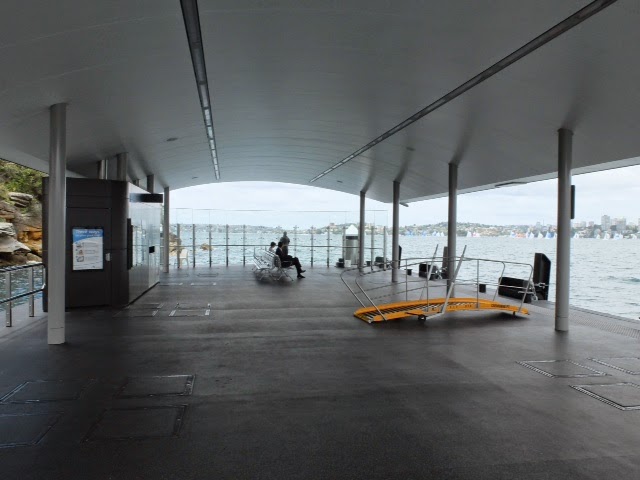

The one nagging concern is whether the pontoon should be just that little longer to accommodate dual berthing at a future point in time. It works fine now with a five minute separation in departures for inbound and outbound vessels, but if we are to have a big pontoon, why not make it that little bit longer so two First Fleeters can berth bow on bow? It might come in handy with future timetable changes.
But this is nit picking. Well done Roads and Maritime Services!
The first upgrade was Milsons Point in December 2010. As new transport infrastructure goes, this wharf was a great disappointment. The pontoon is tiny, passenger ramps are confusing and it lacks the vital ingredient of a ferry terminal at this particular location - a second berthing face so two ferries can load passengers at the same time.
These shortcomings did not stop the Milsons Point wharf winning an architecture prize. The architect's description suggests functional considerations were not front of mind:
"The design responds to the varied and sinuous nature of the harbour's edge and its remnant forests by developing forms, material and colour selections that provide a sophisticated and complimentary group of elements."
Whatever happened to form follows function?
But RMS should not cop all the blame. The upgrade program would have been strengthened by earlier, more detailed planning for the network and fleet replacement. Sydney would then have wharf infrastructure that properly matched the fleet and network.
But let's turn now to the immediate.
The upgraded Cremorne Point wharf reopened yesterday.
It is certainly impressive. And that's not just because of the crystal clear waters of Sydney Harbour lapping on the pontoon, the dappled shade cast by the fig trees on the shore or the views of the Opera House.
While it has the same look and feel of all the wharves in the upgrade program, it is the subtle changes which make a difference. RMS, and probably those who were consulted in the design process, have obviously learnt from earlier mistakes.
For a start, the pontoon is a generous size with the seating area located at the eastern end. As the seats are off to one side, they do not interfere with passenger ingress and egress as they do at Rose Bay, Neutral Bay and Thames Street Balmain.
Fenders are widely spaced and the deckhands seem to have little difficulty tying lines or planking the gangway. The pontoon sits a little high in the water for a First Fleeter, but this can't be helped because of the unfortunate variation in freeboard in the Sydney Ferry fleet.
I haven't seen the Lady Herron berth at the new wharf yet so don't know whether the hydraulic gangways on this vessel pose any problems.
The pontoon should be big and stable enough to withstand the gales that Cremorne Point is famous for.
The one nagging concern is whether the pontoon should be just that little longer to accommodate dual berthing at a future point in time. It works fine now with a five minute separation in departures for inbound and outbound vessels, but if we are to have a big pontoon, why not make it that little bit longer so two First Fleeters can berth bow on bow? It might come in handy with future timetable changes.
But this is nit picking. Well done Roads and Maritime Services!
Thursday, 29 January 2015
Connecting Buses and Ferries
Achieving reliable bus and ferry connections can be a challenge, but it pays off handsomely when they work well.
There are examples in the Sydney Ferry network of both good and bad connections.
Cremorne Point on the Mosman line generally works well. The off peak frequency of both the ferry and connecting 225 bus line is 30 minutes. The 225 bus terminates at Cremorne Point with a 13 minute layover. It arrives five minutes before the inbound ferry to Circular Quay departs at :05 and :35 past the hour. It leaves three minutes after the outbound ferry is due to arrive from Circular Quay at :10 and :40 past the hour. This allows one bus to connect with both the inbound and outbound ferry.
Because the 225 bus line is generally reliable, with just a short section of its route on a congested main road, the bus is well patronised with transfers from the ferry.
It is also a highly legible transfer, because every bus you catch in the direction of the wharf connects with the ferry. And every ferry arriving at Cremorne Point connects with the bus.
Simplicity and reliability make effective connections.
A connection point that does not work well is Balmain East. On first blush, you might expect it would. On week-days, the ferry operates at 30 minute intervals all day. The ferry outbound from Circular Quay departs Balmain East just two minutes before the inbound ferry. This means one bus should be able to can connect with both ferries.
But the connections are neither reliable nor legible.
To appreciate the problem, some understanding is needed of the Balmain peninsula. By Sydney standards, it is densely populated with two main transport corridors:

Four main bus lines operate on these corridors (there are actually more but I won't complicate the story more than I have to), all at 20 minute intervals on week-days off-peak:
The line structure is complex. It's complex because it suffers from what could be described as the "Australian disease" - an habitual preference for avoiding transfers in the bus network, especially for CBD commuters.
Despite the number of buses operating, the connections to the ferry do not work well:
Passengers on the 445 line east of Balmain shops who need to go to the CBD can transfer to the 441 bus where the lines intersect adjacent to Balmain Post Office. Those who need to go to Glebe can take the 445 and transfer at Lilyfield for a Glebe bus.

As both lines have minimum headways of 10 minutes (and could be five minutes in the peaks), waiting time at the transfer point at Balmain shops is short.
And passengers who disembark from the ferry have only a short wait for the connecting bus, with consistent access to anywhere on the Balmain peninsula.
The good news is that fixing the ferry/ bus connections can also lead to a high frequency/ more legible timetable for all bus users, not just those transferring from a ferry.
There are examples in the Sydney Ferry network of both good and bad connections.
Cremorne Point on the Mosman line generally works well. The off peak frequency of both the ferry and connecting 225 bus line is 30 minutes. The 225 bus terminates at Cremorne Point with a 13 minute layover. It arrives five minutes before the inbound ferry to Circular Quay departs at :05 and :35 past the hour. It leaves three minutes after the outbound ferry is due to arrive from Circular Quay at :10 and :40 past the hour. This allows one bus to connect with both the inbound and outbound ferry.
Because the 225 bus line is generally reliable, with just a short section of its route on a congested main road, the bus is well patronised with transfers from the ferry.
It is also a highly legible transfer, because every bus you catch in the direction of the wharf connects with the ferry. And every ferry arriving at Cremorne Point connects with the bus.
Simplicity and reliability make effective connections.
A connection point that does not work well is Balmain East. On first blush, you might expect it would. On week-days, the ferry operates at 30 minute intervals all day. The ferry outbound from Circular Quay departs Balmain East just two minutes before the inbound ferry. This means one bus should be able to can connect with both ferries.
But the connections are neither reliable nor legible.
To appreciate the problem, some understanding is needed of the Balmain peninsula. By Sydney standards, it is densely populated with two main transport corridors:
- Darling Street, which runs from the ferry wharf at the eastern end to Victoria Road at the western end.
- A second corridor runs from Birchgrove in the northern corner to the intersection of Robert Street and Victoria Road in the south.
Four main bus lines operate on these corridors (there are actually more but I won't complicate the story more than I have to), all at 20 minute intervals on week-days off-peak:
- 445 bus runs the length of Darling Street from Balmain East, continues across Victoria Road and terminates eventually at Campsie in Sydney's south west.
- 442 bus also starts at the ferry wharf, but turns south at the Post Office towards Mullens Street before crossing the ANZAC Bridge and terminating in the Sydney CBD.
- 441 bus starts at Birchgrove and runs south, also following Mullens Street down to the ANZAC Bridge and terminates in the CBD.
- 433 bus starts part way along Darling Street at Gladstone Park. It follows Darling Street to Victoria Road, where it turns south, then west along the A4 before turning off to Glebe and finally the CBD.
The line structure is complex. It's complex because it suffers from what could be described as the "Australian disease" - an habitual preference for avoiding transfers in the bus network, especially for CBD commuters.
Despite the number of buses operating, the connections to the ferry do not work well:
- all the bus lines can be subject to traffic delays, so reliability is poor.
- a 20 minute bus interval does not mesh well with a 30 minute ferry interval. If a transferring ferry passenger wants to travel to Rozelle in the western end of the peninsula, only every second service connects with the appropriate bus (445).
Passengers on the 445 line east of Balmain shops who need to go to the CBD can transfer to the 441 bus where the lines intersect adjacent to Balmain Post Office. Those who need to go to Glebe can take the 445 and transfer at Lilyfield for a Glebe bus.
As both lines have minimum headways of 10 minutes (and could be five minutes in the peaks), waiting time at the transfer point at Balmain shops is short.
And passengers who disembark from the ferry have only a short wait for the connecting bus, with consistent access to anywhere on the Balmain peninsula.
The good news is that fixing the ferry/ bus connections can also lead to a high frequency/ more legible timetable for all bus users, not just those transferring from a ferry.
Subscribe to:
Posts (Atom)